> How many splitters did Roki Sasaki throw against the Diamondbacks last night?
> How often has he thrown it relative to his other pitches over his last four starts?
> What does its location look like over that period?
> How does he attack one particular hitter, and does that hitter chase the splitter?
Mound answers questions like these with a few CLI commands or a few lines of Python.
Contents
Get started
Install
pip install mound

# Parquet export support:
pip install "mound[parquet]"

# KDE heatmaps (kind="kde"):
pip install "mound[viz]"
Or from a local checkout (editable):
git clone https://github.com/stiles/mound.git
cd mound
pip install -e .
Requires Python 3.10+.
Quickstart
CLI
# Find a player and their MLB ID
mound search "Roki Sasaki"

# List his games -- date, opponent, home/away, game_pk -- without
# fetching a single pitch (last N appearances, or a whole season)
mound games "Roki Sasaki" --last 4
mound games "Roki Sasaki" --season 2026

# Retrieve pitches from his last 4 starts, or a whole season
mound pitches "Roki Sasaki" --last 4
mound pitches "Roki Sasaki" --season 2026

# Isolate one pitch type
mound pitches "Roki Sasaki" --last 4 --pitch splitter

# Pitch mix and results by pitch type
mound mix "Roki Sasaki" --last 4
mound results "Roki Sasaki" --last 4 --pitch splitter

# Velocity, spin, movement, whiff and chase rate, side by side
mound arsenal "Roki Sasaki" --game 825051

# All of the above for one start, as a single report -- last night's by
# default, or any outing by date, season or game_pk
mound outing "Roki Sasaki"
mound outing "Roki Sasaki" --date 2026-04-18 --out outing.png

# Narrow any command to one opposing batter for a matchup view
mound results "Roki Sasaki" --last 4 --batter "Geraldo Perdomo"

# Plot pitch locations against the strike zone
mound zone "Roki Sasaki" --pitch splitter --last 4 --out splitter_zone.png

# Or count them into the numbered zones instead of plotting each one
mound zone "Roki Sasaki" --pitch splitter --last 4 --kind zones --out splitter_zones.png

# Just the pitch each at-bat ended on, one row per plate appearance
mound pitches "Roki Sasaki" --last 1 --ends-at-bat

# The same question from the batter's side: every pitch he faced,
# across every pitcher, or narrowed to one matchup
mound faced "Shohei Ohtani" --last 5
mound faced "Shohei Ohtani" --last 5 --pitcher "Logan Henderson"
mound faced-games "Shohei Ohtani" --last 5

# mix/results/arsenal/zone/video all have a `faced-` counterpart, built
# on the batter's own game log instead of a pitcher's starts
mound faced-arsenal "Shohei Ohtani" --last 8 --pitcher "Logan Henderson"
mound faced-zone "Shohei Ohtani" --last 8 --out ohtani_zone.png

# Narrow to Statcast's numbered zones: 1-9 in the zone, 11-14 outside it
mound pitches "Roki Sasaki" --last 4 --zone 5

# Export the underlying data
mound pitches "Roki Sasaki" --last 4 --export roki_last4.csv

# Cache Savant responses locally; a later run for the same pitcher only
# fetches the games it hasn't seen yet
mound pitches "Roki Sasaki" --last 4 --cache

# Download broadcast clips for a set of pitches
mound video "Roki Sasaki" --pitch splitter --last 4 --out-dir clips

# Download just one clip
mound video "Roki Sasaki" --pitch splitter --last 1 --limit 1

# Already have a pitch_id? Download its clip directly, no lookup needed
mound video-id 7468ecb9-0918-3aca-8ef5-6396e6ab80c3
Run mound --help or mound <command> --help for the full option list.
Python
from mound import Pitcher

roki = Pitcher("Roki Sasaki")

# Which games, without fetching a single pitch: date, opponent,
# home/away, game_pk -- a plain DataFrame from the cheap Stats API
# game log, no Baseball Savant lookup
roki.games(last=4)
roki.games(season=2026)

pitches = roki.pitches(last=4)
splitters = pitches.filter(pitch_type="splitter")

splitters.pitch_mix()
splitters.strike_rate()
splitters.swing_rate()
splitters.whiff_rate()  # of swings, not of every pitch -- see below
splitters.chase_rate()  # of pitches outside the zone
splitters.plot_zone(out="splitter_zone.png")

pitches.pitch_metrics()  # avg velocity/spin/movement per pitch type

pitches.to_csv("roki_last4.csv")

# Cache Savant responses locally; a later call for the same pitcher only
# fetches the games it hasn't seen yet
pitches = roki.pitches(last=8, cache=True)

# Download a broadcast clip for a single pitch, or a whole collection
splitters.pitches[0].download_video()
splitters.download_videos(out_dir="clips")
Pitcher.pitches() and PitchCollection.filter() both accept:
| Argument | Meaning |
|---|---|
last |
most recent N appearances |
since / until |
date range ("YYYY-MM-DD" or date), inclusive |
game |
one or more MLB game_pk values |
pitch_type |
a pitch name, alias, or Statcast code (see below) |
stand |
batter side: "L"/"left"/"LHB" or "R"/"right"/"RHB" |
batter |
an opposing hitter, by name or MLB player ID (see Matchups) |
at_bat_number |
a specific at-bat — pair with game, since it’s only unique within one game |
pitch_number |
a specific pitch within that at-bat (e.g. 3 for the third pitch) — pair with game and at_bat_number to land on one exact pitch |
.filter() additionally takes what Mound derives rather than retrieves — is_strike, in_zone (see is_strike vs. in_zone), zone (see Zones) and ends_at_bat (see At-bat outcomes) — since those only make sense once the data is in hand.
Filtering a PitchCollection always returns another PitchCollection, so any combination of .filter(), .pitch_mix(), .strike_rate(), .plot_zone() and export methods composes freely.
Concepts
The commands above will get you moving, but a few things about the data are easy to misread until you’ve hit them once. Worth a read before trusting a chart or a rate against a quote.
is_strike vs. in_zone
These sound interchangeable but aren’t, and it’s easy to expect a plotted zone box to reconcile with the wrong one:
is_strikeis whatever counts as a strike by rule: a called strike, a swinging strike, a foul ball, or a ball put in play. It’s about the ruling, not the location — a pitch that draws a swing and a miss (or a foul, or a groundout) well outside the box still counts as a strike.in_zoneis purely locational: does the pitch — modeled as an actual baseball, not a point — overlap the strike-zone rectangle for that batter’ssz_top/sz_bot?
A good chase pitch (splitters, sweepers, low sinkers) will show a much higher is_strike rate than in_zone rate. That’s the pitch working as intended, not a bug — batters are swinging at (or getting jammed by) pitches outside the zone on purpose, which is exactly what chase_rate() measures. If a plot_zone() subtitle’s strike percentage doesn’t match how many dots visually sit inside the drawn box, that’s this distinction at work; check in_zone counts (or .filter(in_zone=True)) for the locational answer, not strike_rate().
in_zone models the ball as a sphere overlapping the zone rectangle, which matches Statcast’s own methodology (checked against Baseball Savant’s own isInZone field across 42,538 cached pitches with zero mismatches — see Zones). One consequence: a pitch can register in_zone=True even when its center is outside the box on both axes at once, as long as it’s within one ball radius of a corner — a legitimate, if visually surprising, edge case. in_zone also reflects Statcast’s calculated geometry, not the home-plate umpire’s real-time call; the two disagree routinely on borderline pitches, especially double-edge corner cases (away and low/high at once). That’s normal umpire variance, not an error in Mound.
Zones
Every pitch carries zone, Statcast’s numbered zones as they appear on Baseball Savant: 1-9 across the strike zone, read like a book from the catcher’s view, and 11-14 for the quadrants outside it. There is no zone 10.
mound pitches "Roki Sasaki" --last 4 --zone 5        # the heart of the plate
mound pitches "Roki Sasaki" --last 4 --zone 11,12,13,14roki.pitches(last=4).filter(zone=5)
roki.pitches(last=4).filter(zone=[7, 8, 9]).whiff_rate() # down in the zoneMound derives this from the pitch’s own coordinates rather than reading Savant’s zone field, the same way it derives in_zone, so the two can’t drift apart. Reproducing Savant exactly takes three details: the grid is drawn over the zone grown by one ball radius, so a pitch an inch above sz_top is zone 1 rather than 11; the thirds are cut from that grown rectangle, not the strike zone proper; and membership still comes from the sphere overlap, whose corners are round, so a pitch clipping a corner diagonally reads as outside. That agrees with Savant’s own zone on all 42,538 pitches in the local cache.
Getting there turned up a real error: the half-plate constant had been rounded to 0.708 feet, five hundredths of an inch shy of the true 17/24. That was enough to put 4 pitches in the wrong zone and to disagree with Savant’s isInZone on 2, which is why the mismatch count above is now exact rather than approximate.
At-bat outcomes
at_bat_result and description describe the plate appearance, not the pitch, and Savant stamps both onto every pitch of the at-bat. Read a pitch table straight and a five-pitch strikeout looks like five strikeouts.
ends_at_bat marks the pitch each at-bat ended on, which is the row those two fields belong to:
mound pitches "Edwin Díaz" --game 823915 --ends-at-batgame.filter(ends_at_bat=True) # one row per plate appearanceIt’s derived from the game feed as pitches are parsed rather than read off a pitch, so it survives narrowing: filtering to changeups first won’t promote an at-bat’s last changeup into its last pitch. Two edges are worth knowing. An at-bat still being pitched marks nothing, since nothing has ended it yet. And an at-bat that ends on a throw instead of a pitch — a runner caught stealing for the third out, roughly one at-bat in 500 — still marks its last pitch, which is where the record ends even though that pitch didn’t decide it.
mound pitches prints at_bat_result only on the row that produced it, for the same reason.
Pitch types
Statcast tags every pitch with a short code. Mound normalizes these into human-readable names and accepts common aliases when filtering, so pitch_type="four-seam", "fastball" and "FF" are all equivalent.
| Code | Name | Common aliases |
|---|---|---|
FF |
four-seam fastball | fastball, four-seam |
FT |
two-seam fastball | two-seam |
SI |
sinker | |
FC |
cutter | cut fastball |
SL |
slider | |
ST |
sweeper | sweeping slider |
SV |
slurve | |
CU |
curveball | curve |
KC |
knuckle curve | |
CH |
changeup | change-up |
FS |
splitter | split-finger |
FO |
forkball | |
SC |
screwball | |
KN |
knuckleball | knuckler |
EP |
eephus |
Note on Roki Sasaki’s signature pitch: Statcast classifies it inconsistently start-to-start — sometimes as a splitter (FS), sometimes as a forkball (FO), depending on its movement profile in a given game. If a pitch_type="splitter" query looks incomplete, check pitch_type="forkball" too, or filter using both.
Working with pitches
Games
Sometimes the question is just “which games” — the last few starts, or everything in a season — with no need for pitch-level detail yet. games() (mound games/mound faced-games) answers that on its own, using the same last/since/until/season selection as pitches() but reading only the Stats API’s game log: one HTTP request per season, no Baseball Savant lookup, so it’s much cheaper than pulling full pitch data just to see what’s there:
mound games "Roki Sasaki" --last 4
mound games "Roki Sasaki" --season 2026
mound faced-games "Shohei Ohtani" --last 10roki.games(season=2025) game_date game_pk opponent_name is_home
0 2025-07-10 1001 Arizona Diamondbacks True
1 2025-08-01 1002 San Francisco Giants False
2 2025-08-15 1003 Arizona Diamondbacks TrueIt returns a plain DataFrame, so the game_pk column feeds straight into pitches(game=...) once you’ve picked which of those games are actually worth the fetch:
roki.pitches(game=roki.games(last=4)["game_pk"].tolist())One outing
mound outing answers the morning-after question in one command — what happened last night — instead of running mix, results and arsenal against the same --game three times:
mound outing "Roki Sasaki"                     # the most recent start
mound outing "Roki Sasaki" --date 2026-04-18   # a particular day
mound outing "Roki Sasaki" --season 2025       # his last start of that season
mound outing "Roki Sasaki" --game 825051       # an exact game_pk
mound outing "Roki Sasaki" --out outing.png    # and the zone chart alongside it
Yoshinobu Yamamoto · 2026-08-21 · vs Pittsburgh Pirates · game 823911
107 pitches · 27 batters faced · innings 1-7 · 64% strikes · 70% first-pitch strikes
Plate appearances
Strikeout 9
Groundout 6
Single 3
Pop Out 3
Hit By Pitch 2
Double 2
Flyout 1
Walk 1
Arsenal
pitches usage% strike% whiff% chase% velo spin hb ivb
splitter 32 29.9 75.0 38.1 55.0 90.9 1402 10.7 1.1
four-seam fastball 28 26.2 60.7 45.5 40.0 95.7 2246 8.6 16.2
cutter 21 19.6 52.4 14.3 8.3 91.5 2466 3.1 8.5
sinker 15 14.0 60.0 0.0 0.0 95.8 2295 15.1 11.0
curveball 8 7.5 75.0 0.0 0.0 76.0 2696 11.4 -15.1
slider 3 2.8 66.7 0.0 0.0 85.7 2781 6.8 0.3There’s deliberately no --last: an outing is one game, and a window of several starts is what mix/arsenal/zone are already for.
The arsenal table is the same one mound arsenal prints, which is what keeps the whole report to one screen. hb and ivb are horizontal and induced vertical break; that section covers the rest of the columns.
Two things the report is careful about. innings 1-6 is the innings he appeared in, not innings pitched — a reliever who enters with two outs still shows up in that inning, and nothing in the feed counts outs, so there’s no honest way to render a box-score line. And the opponent in the headline comes from the game log, which --game skips (a bare game_pk can’t be found there without guessing which season to read), so that route reports the date and the game and stops. A doubleheader is the one case where --date doesn’t name an outing; it lists both game_pk values and asks you to pick.
The two numbers behind the report are available on their own, on any collection:
roki.pitches(game=825051).plate_appearances()      # how the at-bats ended
roki.pitches(game=825051).first_pitch_strike_rate()
plate_appearances() reads only the pitch each at-bat ended on (see At-bat outcomes), so filtering first narrows the question rather than the count: filter(pitch_type="splitter").plate_appearances() counts the at-bats that ended on a splitter, not every at-bat that contained one.
Matchups
Every retrieval and filter takes a batter, so any command or method can be scoped to one hitter. Names match on any part of the name Savant reports, ignoring case and accents — "perdomo" or "Geraldo Perdomo" both work, and an MLB player ID settles a name that’s too common to be unique:
mound results "Roki Sasaki" --last 4 --batter perdomo
mound zone "Roki Sasaki" --last 4 --batter perdomo --out matchup.pngroki.pitches(last=4, batter="perdomo").pitch_mix()
roki.pitches(last=4).filter(batter=[672695, "Lindor"]) # several hitters at onceBatter asks the same question from the other side — the pitches a hitter faced, from every arm he saw. mound faced is its CLI counterpart to mound pitches:
mound faced "Geraldo Perdomo" --last 5
mound faced "Geraldo Perdomo" --last 5 --pitcher "Roki Sasaki"
from mound import Batter
perdomo = Batter("Geraldo Perdomo")
faced = perdomo.pitches(last=5) # everything, across pitching changes
vs_roki = perdomo.pitches(last=5, pitcher="Roki Sasaki")
faced.chase_rate() # how often he chased out of the zone
faced.pitch_mix() # what pitchers fed him
faced.plot_zone(out="perdomo_zone.png")Both sides return the same pitches for a given matchup, so pick whichever player is the subject of the question. mound pitches --batter/Pitcher.pitches(batter=...) is the cheaper route for a one-off matchup, since a starter appears in a fraction of the games a hitter plays and Mound fetches one Savant response per game; mound faced/Batter.pitches() is the one to reach for when the hitter himself is the subject.
Whiff rate, chase rate and pitch metrics
swing_rate(), whiff_rate() and chase_rate() (each with a by_pitch_type option) answer “how nasty was it” from three angles:
| Method | Numerator | Denominator |
|---|---|---|
swing_rate() |
swings | every pitch |
whiff_rate() |
swings that missed | swings |
chase_rate() |
swings | pitches outside the zone |
first_pitch_strike_rate() |
strikes on pitch one | first pitches of an at-bat |
Whiff rate divides by swings rather than by every pitch, matching Baseball Savant’s own convention, so a pitch rarely swung at can still post a high whiff rate on the swings it draws. Chase rate is the out-of-zone counterpart to swing_rate(): how often a hitter went after a pitch he could have taken for a ball. It reads location from in_zone, not is_strike (they differ), and skips pitches with no plate coordinates rather than assuming they were strikes. first_pitch_strike_rate() is split out from strike_rate() because pitch one mostly settles the count a pitcher works the rest of the at-bat from; it follows the at-bat rather than the collection, so narrowing to one pitch type first asks about the first pitches of that type. pitch_metrics() averages velocity, spin rate and movement (horizontal_break, induced_vertical_break) per pitch type.
Compare one outing against a wider window to see what stood out:
last_start = roki.pitches(last=1)
season = roki.pitches(since="2026-03-01")

last_start.whiff_rate(by_pitch_type=True)["splitter"]  # nasty last night?
season.whiff_rate(by_pitch_type=True)["splitter"]      # ...or business as usual?

last_start.pitch_metrics().loc["four-seam fastball", "spin_rate"]  # spinning it more?
season.pitch_metrics().loc["four-seam fastball", "spin_rate"]
The CLI’s mound arsenal puts a pitcher’s whole repertoire in one table — pitch_mix(), strike_rate(), whiff_rate(), chase_rate() and pitch_metrics(), one row per pitch type:
mound arsenal "Roki Sasaki" --game 825051 pitches usage% strike% whiff% chase% velo spin hb ivb
four-seam fastball 35 40.7 57.1 27.3 6.2 98.8 2427 11.2 16.9
splitter 32 37.2 81.2 13.6 57.9 90.2 868 5.3 1.0
slider 14 16.3 57.1 40.0 33.3 87.1 2099 3.0 0.1
forkball 5 5.8 60.0 50.0 0.0 88.2 758 2.8 -2.0The two rates on the right read differently on purpose: the four-seamer lives in the zone (6.2% chase rate) and gets missed when hitters swing, while the splitter’s whole job is to be chased below it (57.9%).
The column names are short so the table fits a terminal: hb and ivb are horizontal_break and induced_vertical_break, and release_extension is left out entirely, since it barely moves between one pitcher’s own pitches. Everything at full length, extension included, is a pitch_metrics() call away in Python. A - marks a number that genuinely isn’t there rather than a zero — no chase rate for a pitch type that never left the zone, no whiff rate where nobody swung, no spin or movement where the park’s tracking didn’t report it.
Every one of these commands has a batter-side counterpart, prefixed faced-, built on Batter instead of Pitcher: mound faced-mix, mound faced-results, mound faced-arsenal, mound faced-zone and mound faced-video ask the same questions from the hitter’s side, e.g. mound faced-arsenal "Shohei Ohtani" --last 8 --pitcher "Logan Henderson".
Tunneling
Two pitches “tunnel” when they look the same for as long as the hitter has to decide, then finish somewhere else. Savant’s feed carries Statcast’s nine-parameter fit for every pitch — a release point, a release velocity and a constant acceleration — which describes the whole flight as a quadratic in each axis, so any point between the hand and the plate is available exactly rather than by interpolation. tunnels() uses it to measure how far apart two pitches were where the hitter had to commit, and how far apart they finished:
roki.pitches(game=823601).tunnels() batter_name at_bat_number first_type second_type commit_separation plate_separation ratio
Marcus Semien 15 forkball four-seam fastball 3.1 17.2 5.5
Marcus Semien 38 four-seam splitter 2.7 12.8 4.8
Juan Soto 23 four-seam slider 5.4 22.8 4.2Separations are in inches. By default each pitch is paired with the one that followed it in the same at-bat, since tunneling is a question about sequence — what the hitter had just seen — and pairs of the same pitch type are skipped. consecutive=False compares every pair within an at-bat instead, and same_type=True keeps the repeats.
plot_tunnel() draws a pair the way the hitter sees it, with an open marker where the swing decision has to be made and a filled one at the plate:
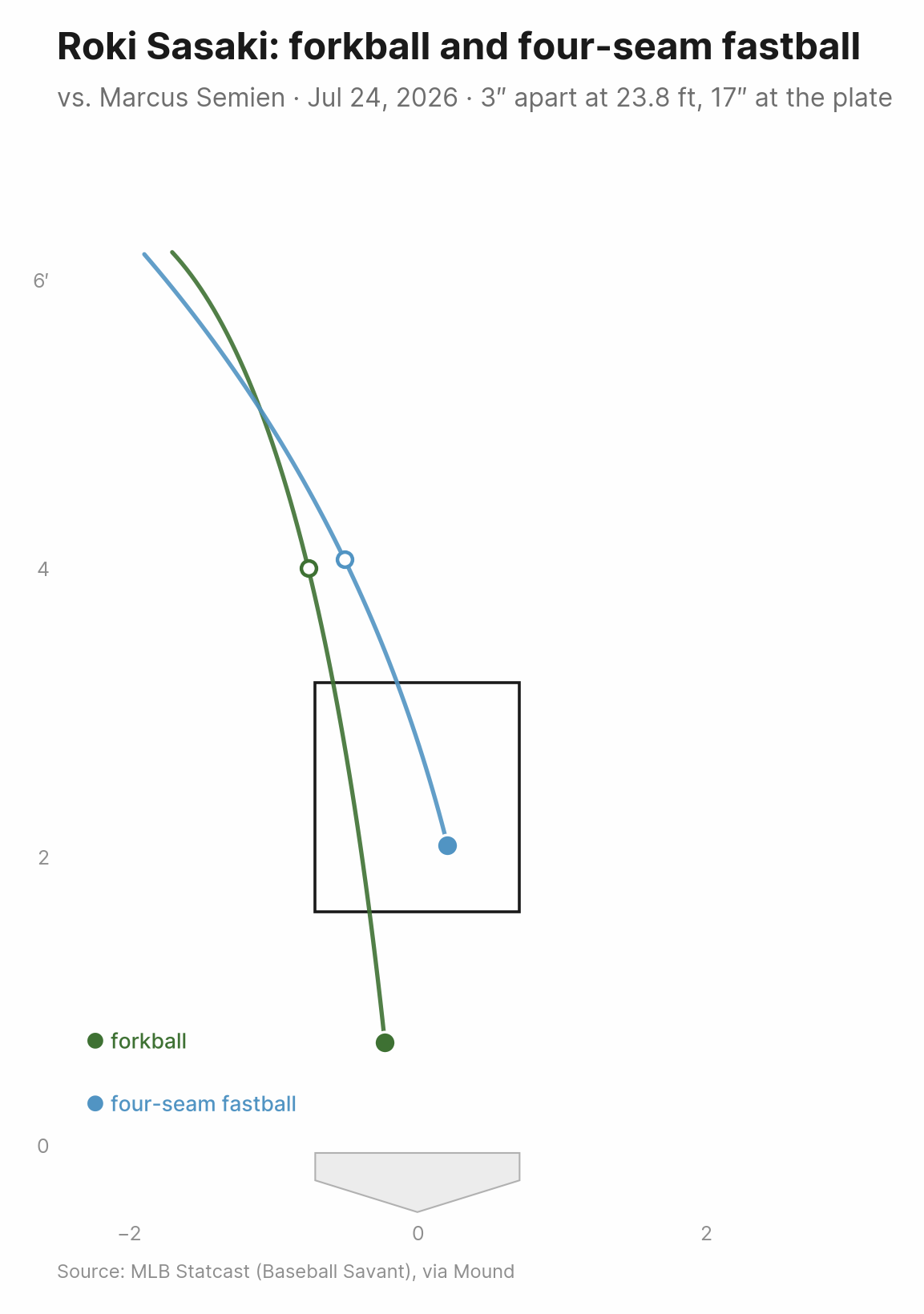
pair = roki.pitches(game=823601).filter(at_bat_number=15).filter(pitch_number=[2, 3])
pair.plot_tunnel(out="semien_tunnel.png")
Handed a collection larger than two pitches, plot_tunnel() ranks it and draws the best pair, so roki.pitches(game=825051).plot_tunnel() is a reasonable way to find an outing’s best sequence without picking one first.
Two things to know before quoting a number from this. The commit point defaults to 23.8 feet from the plate, which is the distance Baseball Prospectus’s tunnel work settled on and so the one to use for comparability — but a fixed distance is 162 milliseconds of a 100 mph four-seamer and 200 of an 80 mph curveball, and the swing decision is a reaction rather than a place, so commit_time=0.167 fixes it at a number of seconds before each pitch’s own arrival instead. And ratio is plate separation over commit separation, which inflates without limit as the denominator shrinks: a pair a tenth of an inch apart at the commit point isn’t meaningfully tighter than one three tenths apart, so the largest ratios describe the tracking’s precision more than the pitcher’s.
The underlying flight path is available on any pitch, for anything these two don’t answer:
pitch = roki.pitches(game=823601).pitches[0]
traj = pitch.trajectory()

traj.plate_location()             # (x, z) where Savant measures it
traj.position_at_distance(30.0)   # (x, z) 30 feet from the plate
traj.path(extension=pitch.release_extension)   # release to plate, as (x, y, z)
plate_location() reproduces Savant’s own plate_x/plate_z exactly, which is what pins the measurement plane: Savant reports it at the middle of home plate (17/24 feet from the point), not the front edge, and the front edge misses by about a tenth of an inch horizontally and three tenths vertically. Checked across 22,482 cached pitches with no disagreement.
Plots
plot_zone() renders a headline, a dek (pitch count, strike rate, date range) and a source line around the strike-zone chart itself, rather than relying on axis titles or a boxed legend:
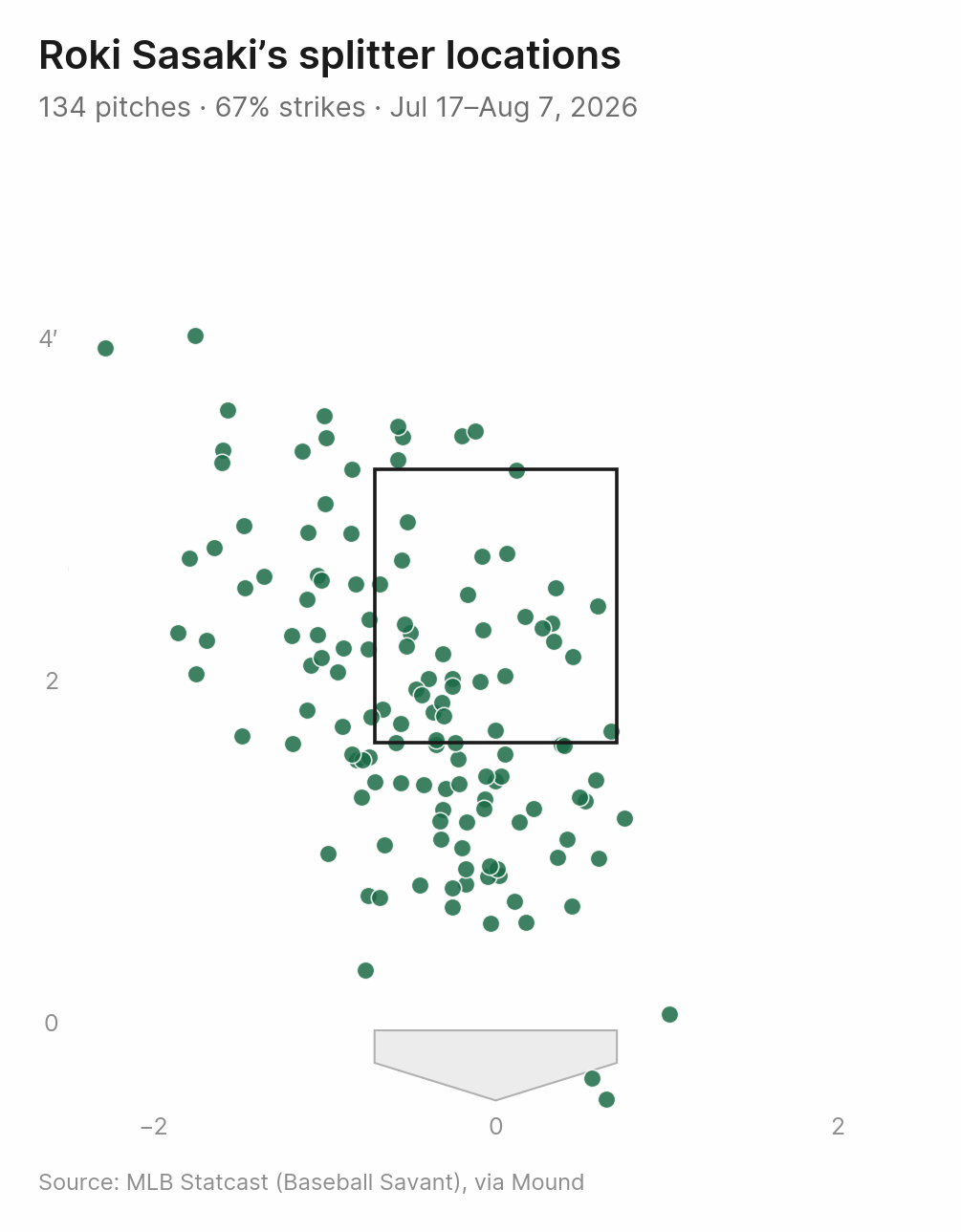
All three are auto-generated but overridable:
splitters.plot_zone(
    title="Sasaki leans on the splitter",
    subtitle="134 pitches since the All-Star break",
    source="Source: Baseball Savant",
    kind="heatmap",  # "scatter" (default), "heatmap", "zones", or "kde"
    out="splitter_zone.png",
)
kind="heatmap" bins pitches into hexagons rather than squares — wide enough to pool pitches thrown a few inches apart instead of scattering them into separate cells, which is what a square grid fine enough to resolve a single pitch’s own footprint does. kind="kde" renders a smoother kernel density surface instead (better suited to larger samples), via the optional scipy dependency (pip install "mound[viz]"). Pass bw_method to control its bandwidth, e.g. plot_zone(kind="kde", bw_method=0.3). Neither carries a colorbar — darker means more pitches, and a vertical scale bar would squeeze the panel out of alignment with every other plot kind.
kind="zones" counts pitches into Statcast’s numbered zones rather than into bins of its own, so the picture is labeled in the same 1-9 and 11-14 that zone and --zone take:
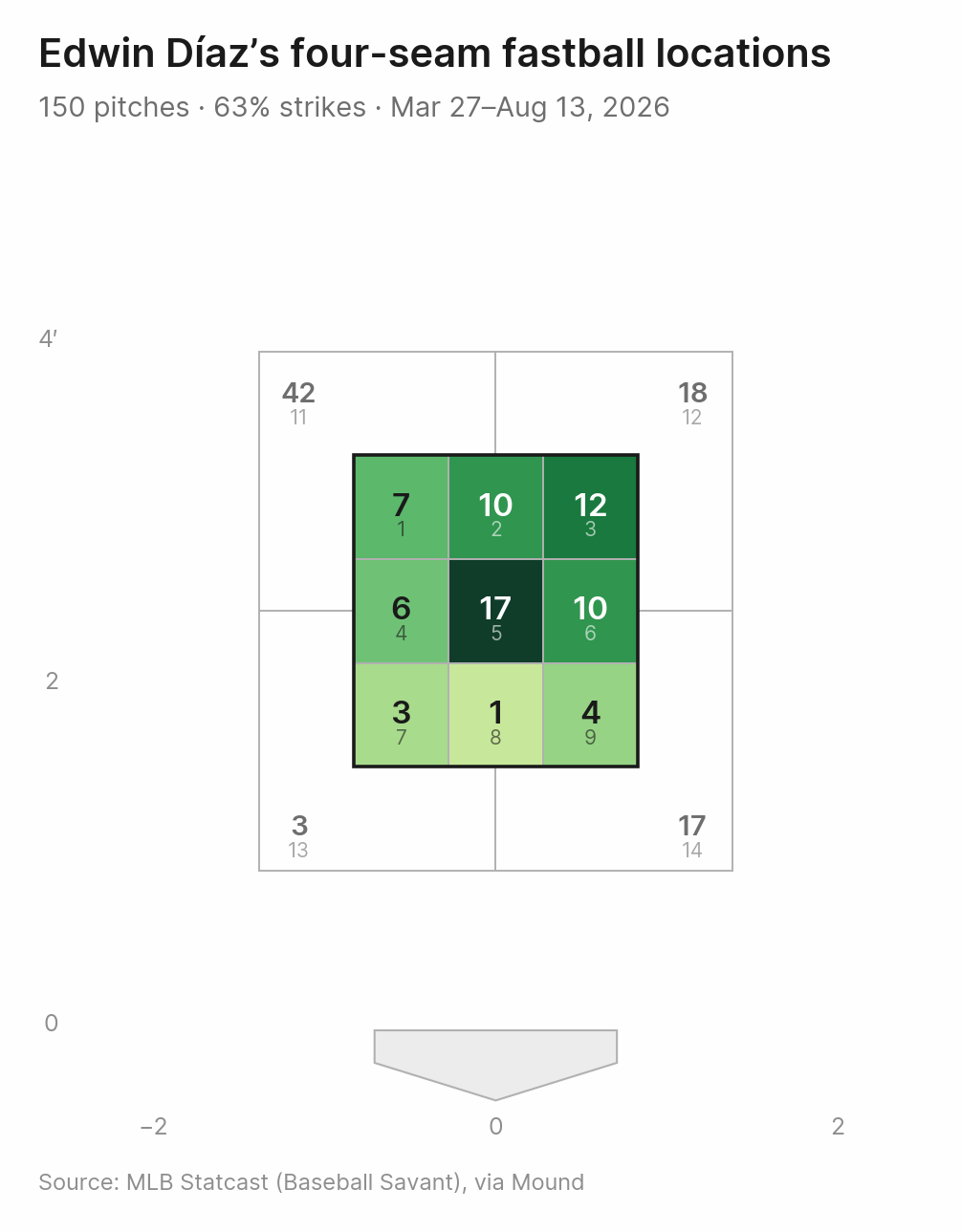
mound zone "Edwin Díaz" --since 2026-03-01 --pitch fastball --kind zones --out diaz_ff_season_zones.pngOnly the nine in-zone cells are shaded. Zones 11-14 run out to wherever a pitch landed, so they collect more pitches than any single cell almost by definition; putting them on the same ramp would darken the border and flatten the nine cells that are the point of the chart, so they carry their counts as numbers instead. The heavy line stands in for the strike zone the other kinds draw and sits a ball radius outside it, because that wider edge is the one the numbering is cut on. Each panel scales to its own busiest cell, so a split_by pair shows the shape of each side rather than their relative volume — the counts are there for that.
A scatter, heatmap or KDE surface can carry the grid without the counts, with grid=True (--grid), which is the cheapest way to read a plot against the zones a --zone filter would return:
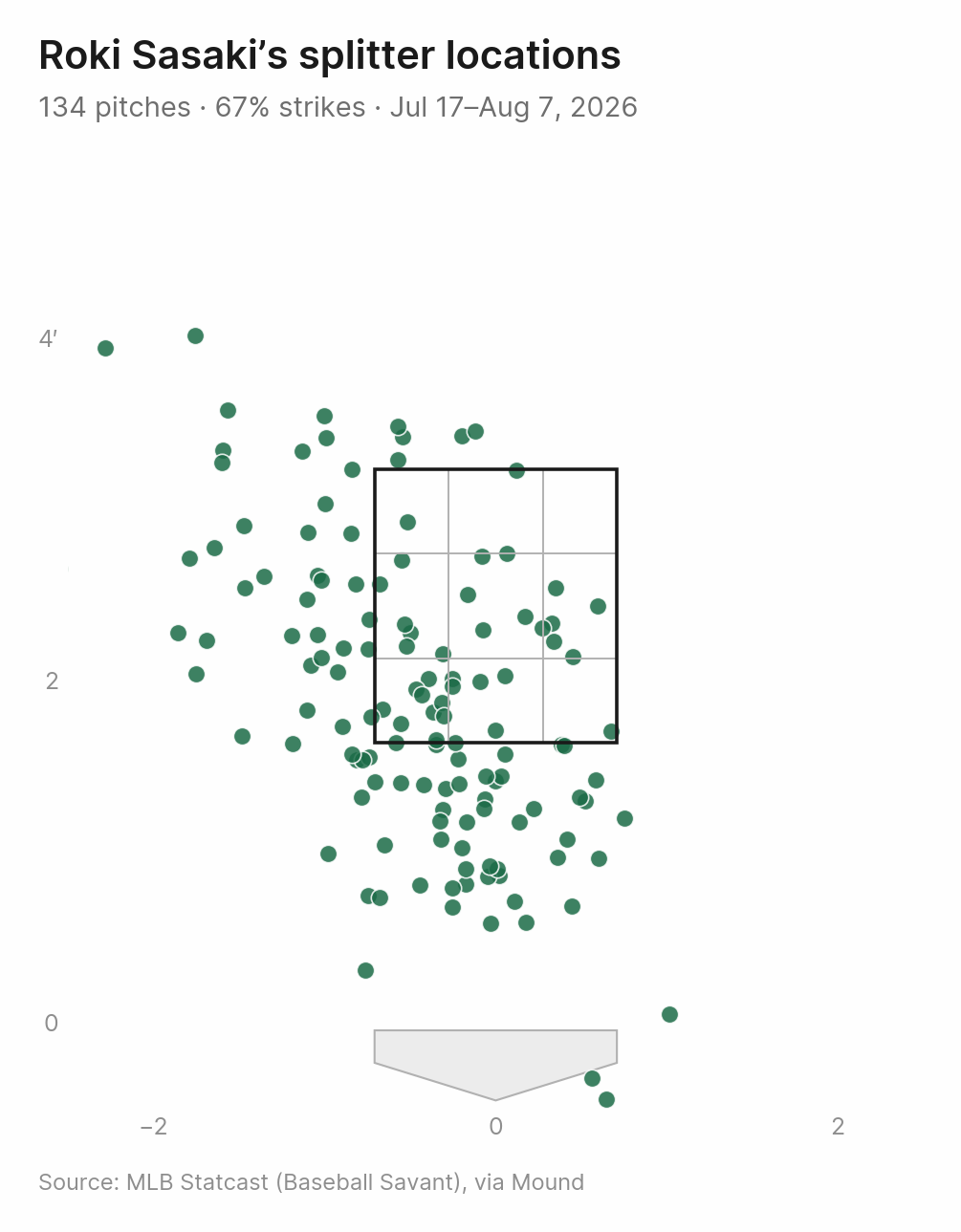
splitters.plot_zone(grid=True, out="splitter_zone_grid.png")Pass subtitle="" or source="" to omit either. Passing your own ax (e.g. for a multi-panel figure) skips the dek/source and falls back to a plain left-aligned title, so plot_zone() behaves as a well-mannered subplot.
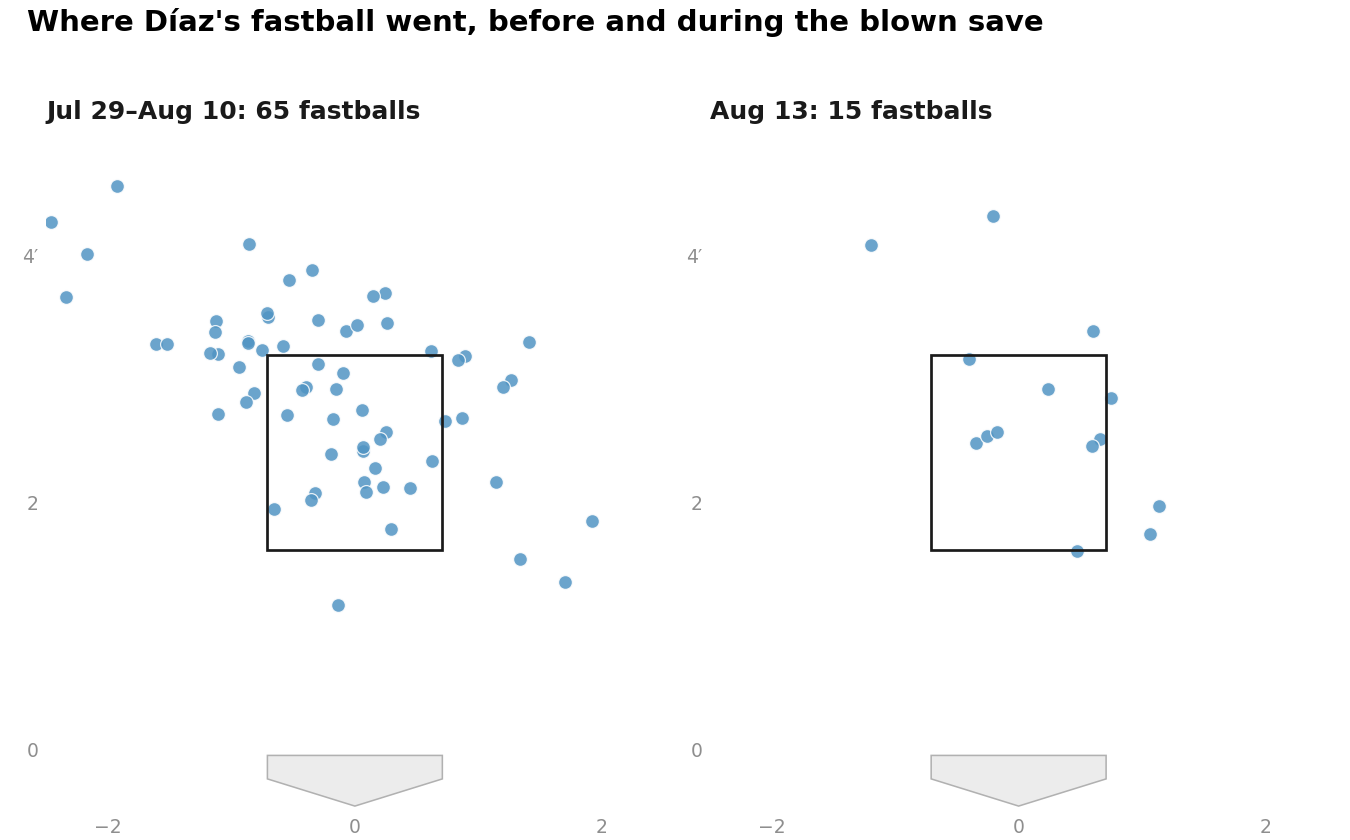
For a comparison you’re assembling by hand — a before/after, two non-adjacent windows, a grid that isn’t one column’s own values — plot_zone_panels() gives a list of (label, collection) pairs the same chrome and the same shared, data-driven frame that split_by gives one collection’s facets:
from mound.viz import plot_zone_panels

plot_zone_panels(
    [("Jul 29–Aug 10: 65 fastballs", before), ("Aug 13: 15 fastballs", aug13)],
    "Where Díaz's fastball went, before and during the blown save",
    out="diaz_ff_panels.png",
)
Pass ncols to wrap into a grid — e.g. pitch type by outing, ncols=2 for two outings per row.
Pitch location isn’t mirrored for batter handedness, so mixing lefties and righties in one panel can blur the picture — pass split_by="stand" to break it into a vs-LHB / vs-RHB pair, each with its own strike zone and pitch count:
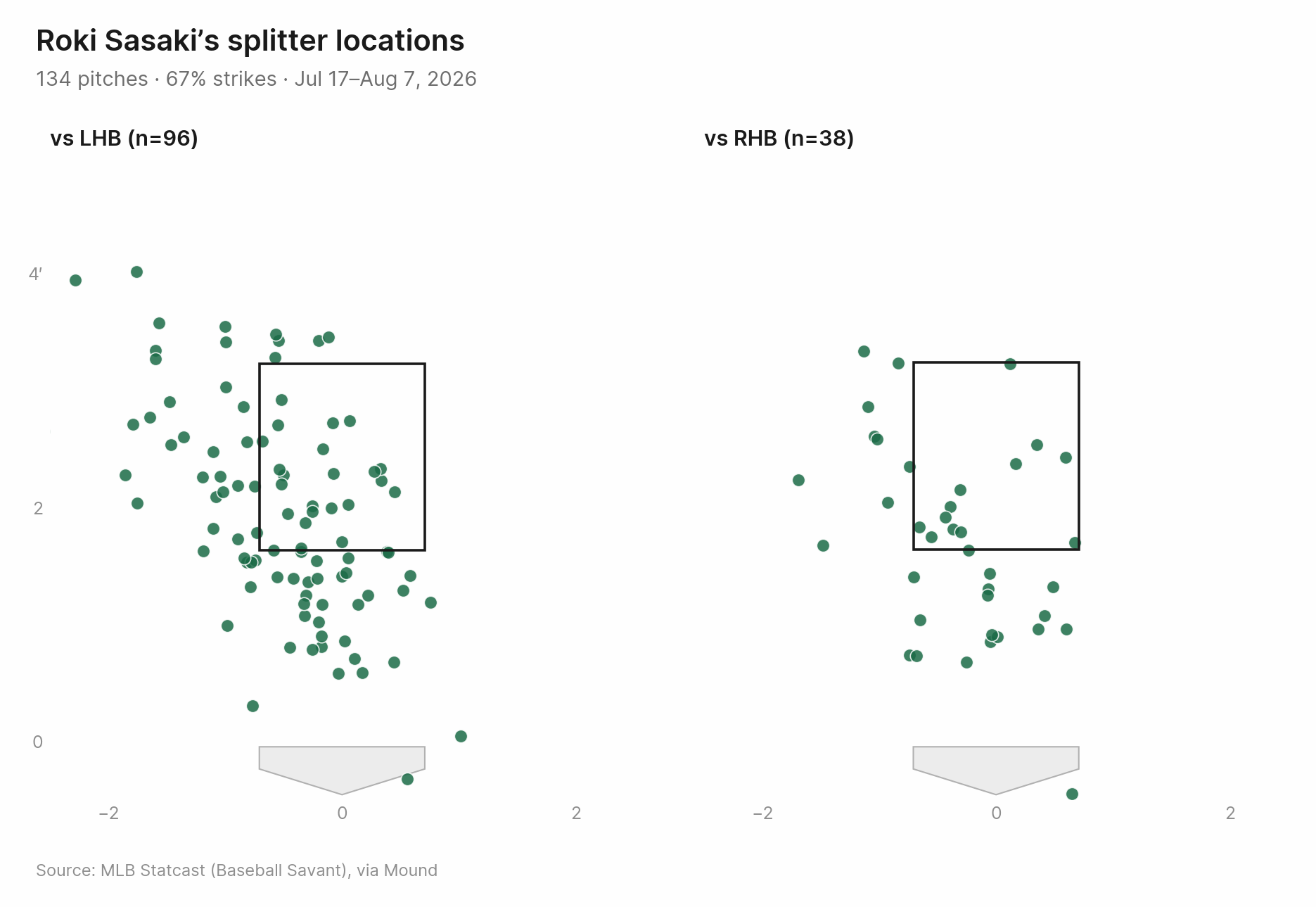
splitters.plot_zone(split_by="stand", out="splitter_zone_by_stand.png")mound zone "Roki Sasaki" --last 4 --pitch splitter --split-by stand --out splitter_zone_by_stand.pngOr keep one panel and separate the two by color instead, with color_by="stand":
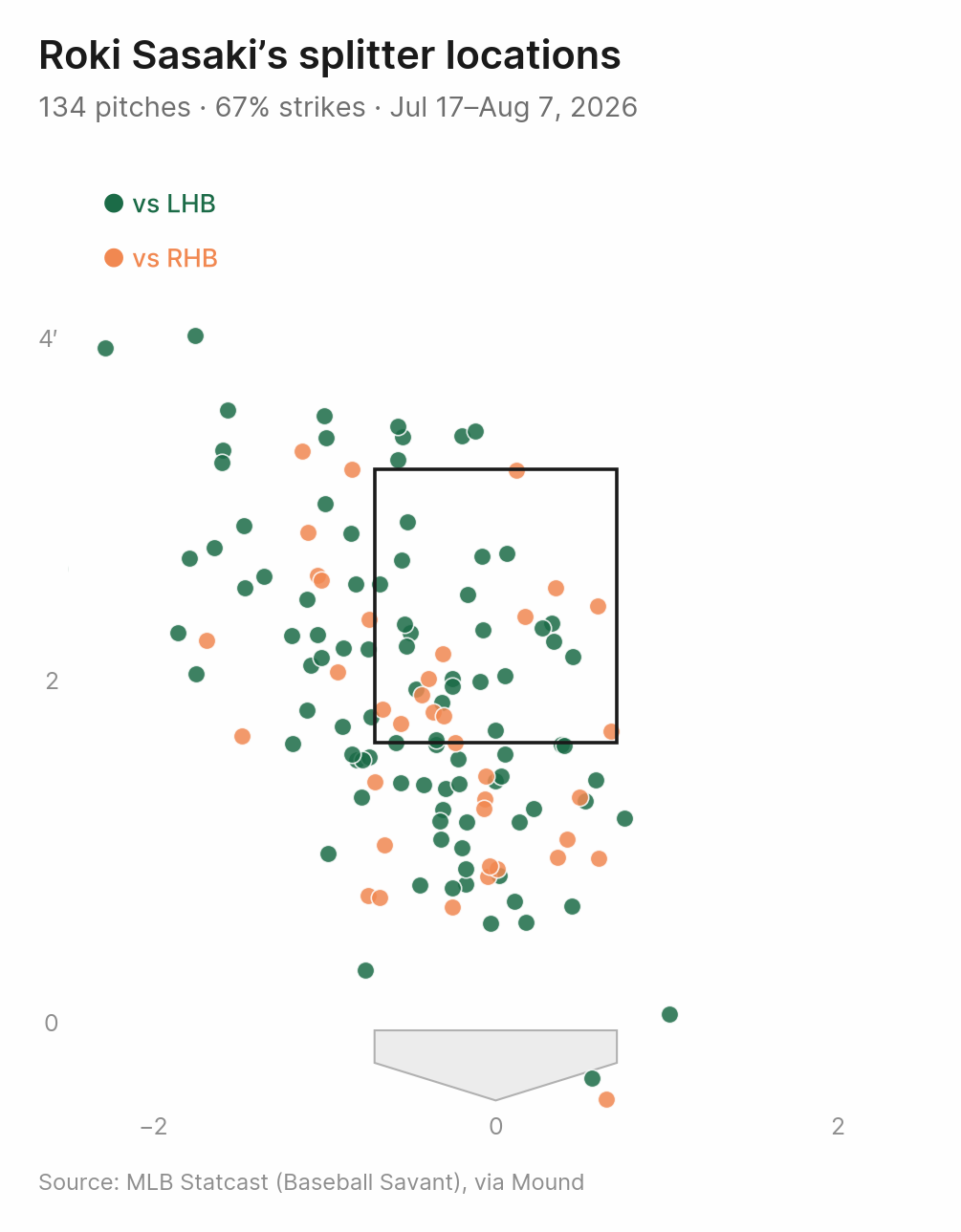
splitters.plot_zone(color_by="stand", out="splitter_zone_color_by_stand.png")mound zone "Roki Sasaki" --last 4 --pitch splitter --color-by stand --out splitter_zone_color_by_stand.pngColoring holds the two groups against the same axes, which is the easier comparison on a small sample; splitting gives each side its own strike zone, drawn from the batters actually faced, which the single panel has to average into one box.
Scatter points are colored by pitch type unless you say otherwise:
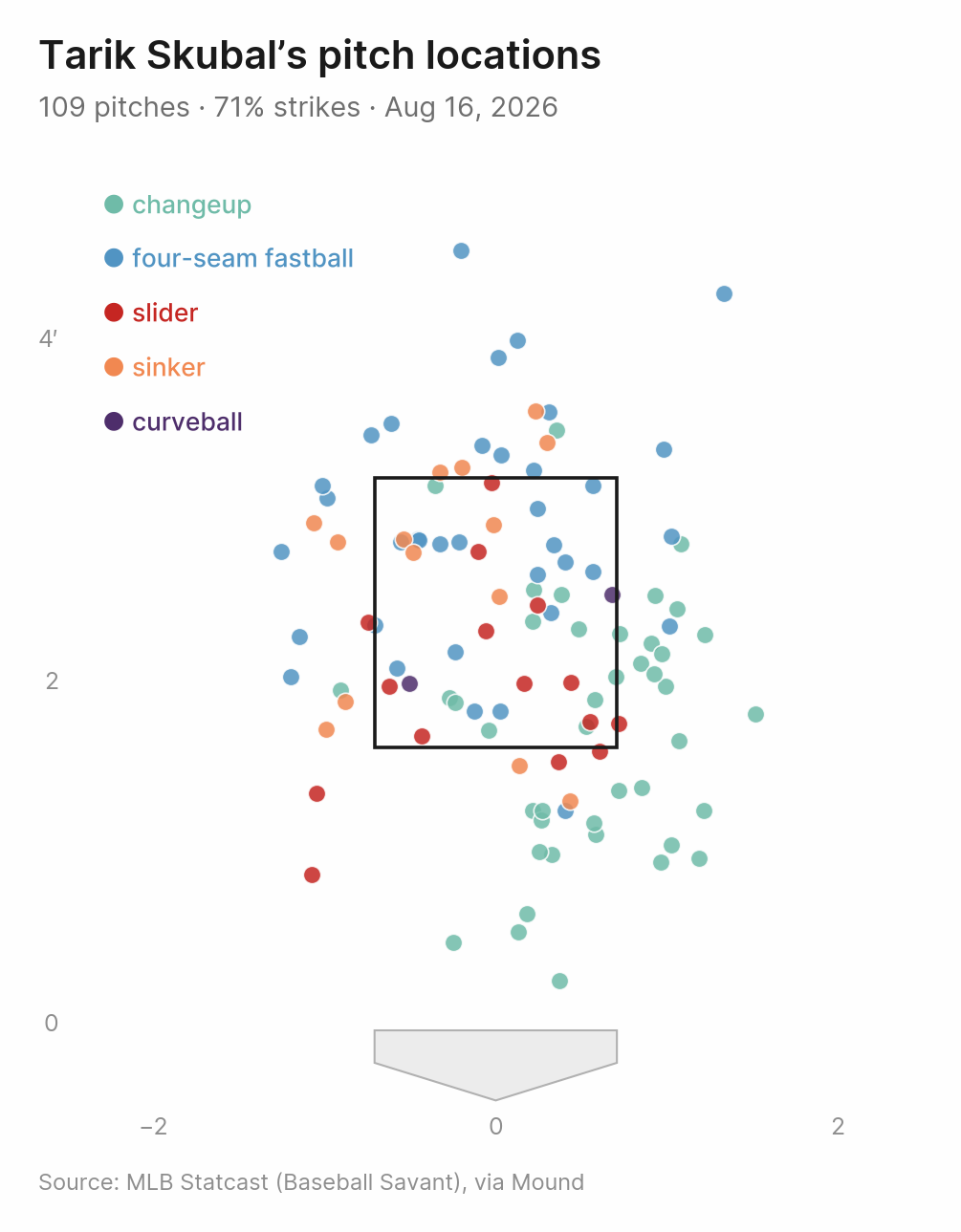
A pitch’s color comes from its name rather than from its position in the chart, so a four-seamer is the same blue in every plot you make. Which pitch got which color was settled by measurement: grouping strictly by family put three shades of one blue on the four-seamer, the sinker and the cutter, which are precisely the pitches most likely to share a chart — a four-seamer and a sinker turn up in the same outing in 286 of 620 cached pitcher-games. The assignment now maximizes perceptual distance between the pairs that actually co-occur, weighted by how often they do and counting red-green color blindness. What’s left of the family idea is the part that costs nothing: the two slider variants stay close, because a sweeper is a slider.
A plot of one pitch type is the exception: the color would separate it from nothing and the headline already names the pitch, so it draws in a single house color instead — which is also what color_by=None (--color-by none) forces. Color is a scatter-only setting; heatmaps, zone counts and KDE surfaces ignore it.
Utilities
Caching
By default every call re-fetches from Baseball Savant. Pass cache=True (Python) or --cache (CLI) to cache each game’s raw Savant response locally, keyed by game_pk:
pitches = roki.pitches(last=8, cache=True)mound pitches "Roki Sasaki" --last 8 --cacheBecause a finished game’s data never changes, a cache hit is never stale — calling again later for the same pitcher only fetches the starts it hasn’t seen yet, without any separate “update” step. The cache defaults to ~/.cache/mound (override with the MOUND_CACHE_DIR environment variable, cache="/some/dir", or --cache-dir).
A game still in progress is the exception, and Mound handles it for you: its feed is returned but never written to the cache, since tonight’s fourth inning would otherwise be all you ever get for that game. Queries against a live game re-fetch every time, and go back to being cached once it’s final.
Video downloads
Each pitch’s pitch_id doubles as the playId on a Baseball Savant clip page, which embeds a direct broadcast clip:
splitters.pitches[0].download_video()          # videos/<pitch_id>.mp4
splitters.download_videos(out_dir="clips")      # every pitch in the collection

# One specific at-bat, or one exact pitch within it
game = roki.pitches(game=717404)
at_bat = game.filter(at_bat_number=34)
at_bat.download_videos(out_dir="clips")                     # every pitch of that at-bat
at_bat.filter(pitch_number=3).pitches[0].download_video()   # just the 3rd pitch of it

# Already have a pitch_id (e.g. from an earlier export)? Skip the
# pitcher/game lookup entirely and download it directly
from mound.video import download_video_by_id

download_video_by_id("7468ecb9-0918-3aca-8ef5-6396e6ab80c3")
mound video "Roki Sasaki" --pitch splitter --last 4 --out-dir clips
# Just one clip: pass --limit to cap how many clips are downloaded
mound video "Roki Sasaki" --pitch splitter --last 1 --limit 1
# One specific at-bat (--at-bat is only unique within a --game), or one
# exact pitch within it by adding --pitch-number on top
mound video "Roki Sasaki" --game 823524 --at-bat 6 --out-dir clips
mound video "Roki Sasaki" --game 823524 --at-bat 6 --pitch-number 3 --out-dir clips
# Already have a pitch_id (e.g. from an earlier export)? Skip the
# pitcher/game lookup entirely and download it directly
mound video-id 7468ecb9-0918-3aca-8ef5-6396e6ab80c3Only the clip page’s default embedded angle is captured this way (in practice, the home broadcast feed) — the page’s away-broadcast toggle loads its clip via client-side JavaScript rather than a second tag in the page’s HTML, so it isn’t reachable with a plain request. Pitches with no video coverage are skipped with a warning by default; pass skip_errors=False to raise instead.
Project
Examples
-
Is Díaz back? Two outings offer reasons for hope — check a viewing hunch against four outings: fastball velocity, missed bats, and better results, with the counts and context behind the comparison. Runnable as
examples/diaz_two_windows.py. -
Did Díaz miss “right in the middle”? — a full walkthrough, from a pitcher’s name to a fact-checked postgame quote: finding his recent games, pulling every pitch, breaking down the mix and arsenal, testing a claim about location against the data, and downloading the video. Runnable as
examples/diaz_blown_saves.py. -
Is Ohtani chasing spin away? — the same treatment from the hitter’s side, testing a hunch from watching games: counting plate appearances with
ends_at_bat, finding the pitch each strikeout ended on, working out which side of the plate is “away” from hit-by-pitch locations, and splitting chase rate by pitch family and side. Runnable asexamples/shohei_spin_chase.py, withexamples/shohei_strikeout_supercut.pystitching every strikeout’s clip into one labeled video. -
examples/roki_sasaki_end_to_end.py— the shorter tour: retrieve, filter to one pitch type, calculate, plot, export.
Data sources
Mound calls two unofficial, public MLB data services directly:
- MLB Stats API — player search/lookup and game logs, used to resolve a pitcher’s identity and discover which games to pull.
- Baseball Savant — the
/gfgame-feed endpoint, used for pitch-by-pitch Statcast data (location, velocity, pitch type, count, outcome).
Both are unofficial and undocumented; endpoints or response shapes could change without notice. Mound sends a descriptive User-Agent and retries transient failures. Responses aren’t cached unless you opt in with cache=True/--cache (see Caching).
Known limitations
- Caching is opt-in and off by default — every call re-fetches unless
cache=True/--cacheis given, and games in progress are never cached (see Caching). - Pitch classification comes from Statcast’s own model and can be inconsistent for pitches with unusual movement (see the Roki Sasaki note above).
in_zoneis Statcast’s calculated geometry, not the umpire’s call, andis_strikeisn’t the same thing as “located in the zone” — seeis_strikevs.in_zoneabove.- Historical data availability depends on Statcast/Savant coverage, which is generally reliable from 2015 onward.
- All requests are synchronous and unthrottled beyond basic retry/backoff; heavy bulk retrieval (e.g. a full season) will be slow.
- Video downloads only capture a clip page’s default embedded broadcast angle (see Video downloads).
Development
pip install -e ".[dev]"
pytest
ruff check .
Tests run entirely against mocked HTTP fixtures in tests/fixtures/ (via the responses library) and don’t require network access.
Releases go out through ./scripts/publish.sh, which bumps the version, tags and creates a GitHub release; the PyPI upload happens in CI when that release is published, not on your machine. See PUBLISH.md.
Roadmap
See ROADMAP.md for planned enhancements beyond this prototype.
Changelog
See CHANGELOG.md.
One source, two places
This page renders the repo’s own README.md, the same file that ships with the package on PyPI, so the two can’t disagree about what a command does.